Wednesday, September 30, 2015

The Word is Out...

After arriving unexpectedly back on the 14th of September (at least to the villagers and clinic staff who were not expecting me - see my first post from Chanaute), word has continued to spread and the clinic has started to get busy. Last week I averaged about 12 patients per day and after starting the week with 13 patients each on Sunday and Monday, we jumped up to 21 yesterday and today we had 24.
Yesterday I also had an interesting case. A gentleman who I would guess was in his 40s or maybe 50s came into the clinic with severe acute leg pain in his right posterior/lateral thigh and calf. I was busy with another patient but my translator asked if acupuncture would help. I suggested we have him drink some water right away in case he was experiencing cramping due to dehydration (he claimed he had experienced cramping before and this was different). After I finished with the patient I was working on, I placed a couple of auricular needles in his ear to try to help calm him down and help with the pain. It seemed to help as he did calm down and no longer appeared to be in quite as severe of pain. The nurse had him lie down and applied a topical muscle analgesic to his calf and wrapped it. I then asked if he was having any low back pain because I thought perhaps he may have some nerve impingement further up stream. He indicated he had a little. I placed needles at L5, S1, S2, (based on the nerve root/dermatomes chart) and UB54, GB30 as well as the bladder xi cleft point of UB63. The gentleman was in so much pain at this point that he was shaking on the bed. The nurse placed a blanket over him. About an hour later I took his needles out and he walked out of the clinic. At that time he did not appear to be in any distress, but I was busy with other patients so I wasn't able to find out exactly how he felt. I'm honestly not sure if it was the fluids we had him drink, the analgesic cream and ace bandage the nurse applied or some of my needles that appeared to help him. Thankfully he seemed to be much better when he left which is what matters most.
After my shift I went for another short hike along a stretch of road I hadn't explored yet heading south east from the village. The view and the sky were amazing. After taking a few pictures like the one below, I happened upon one of the women I'd been treated in the clinic for knee pain.
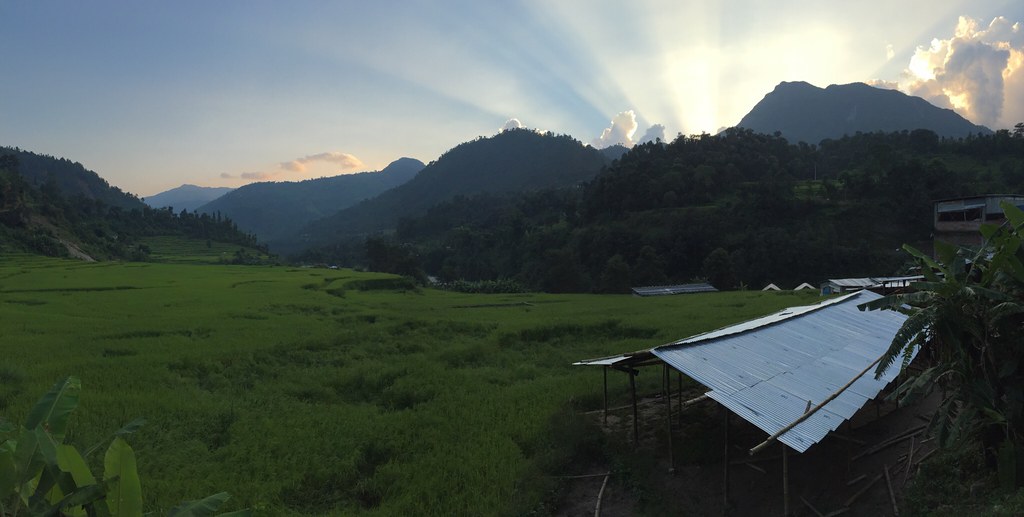


She doesn't speak much English and so at first I thought she said I should "go home." I thought maybe because it was starting to get dark or something. However, her husband came along and the way he motioned at me made me realize they were actually inviting me into their home. I followed them down the path and sat down in their living room floor on a bamboo mat while my patient (most everyone has long difficult names and I see so many people that I can't remember her name) made me milk tea and I smiled and said namaste to her two little girls who were both adorable and smiling right back at me. There wasn't much talking at first, but then her two older children showed up (a boy aged 9 and girl aged 15 and they both spoke some English so I asked if they wanted to see some pictures I'd taken since I'd been in Nepal and we scrolled through them for the next 15 minutes. After finishing my tea, I thanked them for their hospitality and made my way back to the village.


- Posted using BlogPress from my iPhone

Sunday, September 27, 2015

Temporary Clinic and Daily Schedule

Back in my first post from Chanaute I included a picture of the temporary clinic which is actually made up of two separate buildings that look like they are joined but the rear structure was built about a year ago and the front building is an older building made of stone and cement (by our standards it could use some serious tuck pointing). The front clinic is where the midwives/nurses administer to the general health needs of the residents of Chanaute including first aid and dispensing western medicines. Behind this clinic room is the newer building that also has a clinic room which is where I'm treating patients each day. See picture below.


On top of these two small structures is a temporary metal shed that is bolted into the stone and cement buildings below and consist of five rooms. The front room serves as a meeting room for the clinic director and is used for everything from town meetings to construction planning as far as I can gather. The next room houses the three guys who perform the heavy construction projects (like building a retaining wall nearby for some new housing that will be built). During the day this room is sometimes used for other purposes like holding a informational meeting for local residents on how to apply for a work Visa abroad. The next room is a kitchen which is where Bina, one of the midwives cooks and where we both eat.


The last two rooms are bedrooms. One for Bina and one for myself.
Last but not least are the bathroom (a small tiled room with a sink and a hose from outside that supplies running water constantly and prevents you from closing the door completely) and a second toilet room that has an Asian style toilet (essentially a porcelain sink like structure that feeds into a hole in the ground that you squat over). I will say there are at least two advantages to this style of toilet. First, if you are not already aware, there are many who believe that it's better for your colon to squat during your bowel movement, so much so that there are devices sold that help you obtain a similar position with a standard toilet, thus creating what some call a squatty potty. Second, for anyone who has used a public toilet and wondered how clean that toilet seat is, with an Asian style toilet your bum never comes in contact with a seat since there is no seat. I actually think we should make all public toilets Asian style everywhere. :-)

My daily schedule so far usually involves waking up between 6:00-6:30, and starting my day by either going for a morning hike or doing some light exercise in my little room. Unfortunately I don't really have a good space to do Tai Chi at the moment.
After my morning exercise I either clean up (i.e. Take a cold bucket shower) or freshen up (comb my hair and put on some new deodorant). From what I can tell, the people of Chanaute don't generally shower every day based on my observations. Twice a week seems to be the high standard. But I'm guessing that many locals shower once a week or as they deem necessary. I actually haven't minded the cold bucket showers so far, but that may change as the weather and the local water source gets colder. After I clean up I meditate for about 20 minutes and then I have tea and breakfast.
At 9:00 am I start seeing patients in the clinic and work until about 11:30 before having lunch. Then it's back to the clinic until 4:00 or 5:00 depending on how busy we are that day.
The remainder of the day is spent doing some reading, listening to an audiobook, writing blog updates or drawing before having dinner and then calling home.


- Posted using BlogPress from my iPhone

Saturday, September 26, 2015

Greetings from Boudha

Today I've traveled on my off day to Boudha to visit the world heritage site, the Boudha Stupa. I've endured the nearly four hour bus ride of nonstop jolting and jostling (smooth roads, whether paved on unpaved, are nearly non-existent in Nepal) to not only visit this amazing place, but also to pick up some much needed breakfast supplies (more on that in a second) and to figure out the buses, so I can get around without paying a high price for a taxi.

As for breakfast, my first two weeks I've been eating either these processed biscuits (essentially cookies) with tea, or these delicious but very greasy molpas, that are like an unsweetened donut without a hole, essentially fried dough balls.

The first picture below I took this morning. The second picture is what the stupa looked like before the earthquake.

I'm handing over the blog writing to rough guides who can do a much better job of telling you about this amazing place...
The great white stupa at BOUDHA (or BOUDHANATH), about 5km northeast of central Kathmandu, is the swollen sacred heart of a thriving Tibetan Buddhist community. One of the world’s largest stupas – Tibetans call it simply Chorten Chempo, “Great Stupa” – it is also the most important Tibetan Buddhist monument outside Tibet. Since 1959, Boudha has been the focus for Tibetan exiles in Nepal, but it has been a sacred site on the Kathmandu–Tibet trade route for centuries. The 10km corridor from Pashupatinath to Sankhu was known as the auspicious zone of siddhi (supernatural beings), and Boudha was – and still is – its biggest, most auspicious landmark.


Some history

Traditions differ as to the stupa’s origins. A Tibetan text relates how a daughter of Indra stole flowers from heaven and was reassigned to earth as a lowly poultryman’s daughter, yet prospered and decided to use some of her wealth to build a stupa to honour a mythical Buddha of a previous age. She petitioned the king, who cynically granted her only as much land as could be covered by a buffalo hide. Undaunted, the woman cut the hide into thread-thin strips and joined them end to end to enclose a gigantic area.

The Newari legend has a firmer historical grounding, involving a drought that struck Kathmandu during the reign of the early Lichhavi king, Vrisadev. When court astrologers advised that only the sacrifice of a virtuous man would bring rain, Vrisadev commanded his son Mandev to go to the royal well on a moonless night and decapitate the shrouded body he would find there. Mandev obeyed, only to find to his horror that he had sacrificed his own father. When he asked the goddess Bajra Yogini of Sankhu how to expiate his guilt, she let fly a bird and told him to build a stupa at the spot where it landed, which was Boudha.

Whatever its legendary origins, it’s possible that the core of the stupa dates as early as the fifth century AD, and it’s almost certain that it encloses holy relics, perhaps parts of the Buddha’s body (bones, hair, teeth) and objects touched or used by him, along with sacred texts and other ritual objects. The stupa has been sealed for centuries, of course, so no one knows exactly what lies within, but the relics are held responsible for the stupa’s power, and its ability to command veneration.


Read more: http://www.roughguides.com/destinations/asia/nepal/the-kathmandu-valley/boudha/#ixzz3mqHkvyYl


- Posted using BlogPress from my iPhone

Location:Boudha Main Road,,Nepal

Wednesday, September 23, 2015

Earth shake

On my second or third night in Chanaute I awoke and thought I felt a vibration of some sort. I wondered if this might be a light aftershock but I didn't see anything in my room moving or falling off the ledge where I had a few items so I dismissed it as my imagination. Then last night I again awoke and felt a vibration but this time I was pretty sure it was a very minor aftershock. Again, nothing was rattling off the ledge, so it was definitely minor. Later that day one of the locals asked me if I felt the earthquake last night so I'm sure that there was indeed a minor aftershock last night.
In case any of you are worried about my safety, my room sits above a newly constructed clinic room that was built by an engineer to withstand earthquakes and this part of the structure has withstood the two earthquakes that occurred last spring, so you can rest easy that I'm in a safe place.

Below are a couple of pictures from my hike yesterday morning.


North of Chanaute...


-Posted using BlogPress from my iPhone

Where in the world is Dave

Prior to coming to Chanaute I did a few Google searches to try to find out exactly where Chanaute is in relation to Kathmandu. Google maps was not helpful and so I relied on mapcarta.com. Each time I searched it came back that Chanaute was southwest from Kathmandu. On the drive out of Kathmandu I remember thinking that I hope the driver is taking me to the right place because it didn't seem like we were heading in a southwest direction. Once I got here and saw the orientation of the Melamchi river to the sun I realized the we must have traveled north not south from Kathmandu. I finally got the opportunity to try google maps ability to triangulate my location today and sure enough I'm north of Kathmandu (if indeed Google is correct). See the blue dots on the two images posted below.


According to goggle maps, I'm only 19 miles north of Kathmandu, but as I noted on an earlier post it took almost four hours to get here so I'm not sure I trust google on that one. Perhaps it's 19 miles if you could fly here in a straight line.


At any rate, if you were curious as to exactly where I am, hopefully this clears it up.

-Posted using BlogPress from my iPhone

Sunday, September 20, 2015

Nepal signs new constitution

After going eight years without a constitution, Nepal celebrates the promulgation of the new constitution today with an official ceremony here in Chanaute and throughout the country.

Hasta, the clinic director who is from Chanaute but who has a home and business in Kathmandu, believes the new constitution is a step in the right direction for the diverse country with over 100 languages and hundreds of different ethnic groups and castes. I'm unable to get a read from the majority of villagers on how they view the constitution just yet,
but from what I've read its mostly the smaller minority groups in the South and West that are the most dissatisfied.

Below are two articles regarding the new constitution and what it means for Nepal.

http://thediplomat.com/2015/09/nepals-new-constitution-65-years-in-the-making/

http://www.bbc.com/news/world-asia-34280015

The ceremony today has been going on for a couple of hours and included several speakers. There has been lots of music and dancing also with some well known singers from Kathmandu and the surrounding villages.


Hopefully this is a step toward a better and stronger Nepal. Only time will tell.


-Posted using BlogPress from my iPhone

Friday, September 18, 2015

End of First Week

Each day that passes I become a little more acclimated to living in the remote village of Chanaute and I've started to feel more useful. After treating 2 people on Wednesday and 4 people on Thursday, I was also able to treat 10 people yesterday, so it felt really good to get busy and see that word is spreading that acupuncture is available again after 4 months without anyone since the earthquake. While I still feel very much like a stranger in a strange land, I'm starting to get to know the wonderful people here. Yesterday as I was treating one of the villagers a young boy was watching with keen interest. He then noticed the school supplies with pads of paper, pens and colored pencils that I had brought from Kathmandu. He smiled and gestured that he would like to have some. After I gave him some pads and pencils, I soon had a stream of kids coming to the clinic asking if they too could have some school supplies. It was awesome to see their excitement. Many of them stuck around for a while and watched as I treated more patients with acupuncture.


It seems most if not all the children learn English in school and some speak even better than the adults. I suspect this is because it's fresh in their minds while most of the adults lose the skill because they don't have a great deal of people to practice with or reason to keep up the language living in such a remote village. Later I met another 8 year old boy named Saugat who was friends with Bonnie, one of the past volunteers, and he spoke pretty good English as well. He found out later that I was giving out supplies and came by this morning to see if he could get some too! Of course I happily obliged him.
Saturday is my one day off each week. Today I went for a morning walk and I think the villagers are getting use to these strange westerners going for morning walks (the villagers walk all the time for work or to get around that the concept of walking for exercise and enjoyment is foreign to them). I know Bonnie always went for walks, so today when I passed a man he smiled and nodded when I told him I was doing a morning walk.


- Posted using BlogPress from my iPhone